Thursday, November 19, 2015

Market Garden


Operation Market Garden
Jay Stone
Sergeant, at the Time Private
Battery B, 321st Glider Field
101st Airborne Division

The days dawn early in the Army and September 17, 1944 was no exception and we were up early, drew our parachutes and other equipment. I drew an equipment bag and packing for our radio and batteries. The packing would line the equipment bag and cushion the radio when the bag hit the ground. The bag was going to be hung on an equipment rack under the wing of the aircraft in which we would fly to Holland It would be released when we jumped. I packed the radio and a soldier from the air force hung it from the wing of our aircraft  I carried my individual and personal equipment in a musette bags hanging in front of my chest and from a web belt. I don’t remember what I had in the musette bag other than rations. I carried my folding stock carbine in a scabbard attached to my web belt on which I also carried a canteen, ammunition, a compass and a wound dressing. Shortly before boarding the aircraft we put on our parachutes, the main on our backs and the reserve on our chests.
During February 1944 I had
 attended jump school in
England. We were given
48 hour passes after we
completed the ten day
course. I went to London
and had this picture taken. 
 I was proud, full of
myself and ready to tackle
whatever came my way. 
Operation Market-Garden was on. Our battalion, the 321st Glider Field Artillery Battalion, which as to land via gliders on D+2, September 19th was to be in direct support of the 506th Parachute Infantry Regiment. In the interim, our Forward Observer (FO) team with the 3rd Battalion of the 506th, whad the mission of adjusting fires of the UK XXX Corps Artillery. It consisted of Second Lieutenant Francis Canham, a replacement officer who had joined us after Normandy; Corporal Paul myself and another replacement, Private John Brasswell. Canham and Galant were to jump in with the commander of the 3rd Battalion,while Brasswell and I were to jump with the executive officer. Canham and Galant were, by far, the most qualified Field Artillerymen in the team. I suggested to Canham that if his aircraft went down, the battalion would be left with Brasswell and myself as FOs. This was, to say the least, a less than desirable situation; far less than desirable. I pointed out that if anything happened to him, Galant was the best qualified to take over and that he should consider each of them riding in different aircraft. He saw the wisdom of this and selected me to fly in with him. Galant and Brasswell were to go with the battalion executive. Such was my contribution to the planning of Market-Garden.

It occurred to me recently that I had more time in combat than any of my comrades in our FO team. Galant had been wounded during his first day of combat in Normandy and I had gone up o replace him and, as a radio operator, made it through all of our combat there. Despite this I was less qualified than either Canham or Galant, both of whom were trained to adjust the fires of our battalion. That is what our team was there for. Brasswell was less qualified than I in that he was not trained to conduct the fires of our battalion and had seen no combat. Despite the lack of combat experience and the lack of some training on the part of my comrades and myself, I had lots of confidence in each of them and in our team. I was jumping into combat with the "A" team.  

After we boarded the pilots fired up the engines of the many C47s on the field that day. The roar was unimaginable. There must have been more than a hundred aircraft all with two
C47s lined up at Membury
preparing for takeoff.
engines roaring. We taxied to the end of the runway, got the signal to take off and the pilot gunned that ship down the runway. Even today on commercial aircraft I feel a charge when the aircraft accelerates down the runway and is soon airborne. It’s a thrill each time. It was different on that day, though. It was a thrill but I was off on my first combat jump and the adrenaline was racing through my body.  I was sitting on a bucket seat and just beside my ears those piston powered engines were vibrating fiercely and hammering, a sound no longer heard on the aircraft on which I travel. As we lifted off I probably said goodbye to England and its people, an England which had been so kind to me and which I was not to see again for 30 years. There must have been a special goodbye to Kathleen whom I was to miss during the next year on the continent. (See The Silver Summer.) But then, the Army did not send me to the ETO for its good social life. I knew that and was content. After all, I was in that C-47 because it was where I wanted to be.
September 17th was a Sunday, another beautiful day by which to remember an England of which I was growing fonder all the time.  Many airborne soldiers had made dates for the 16th, a Saturday. On that evening we were locked into airfields and we could not let anyone know where we were. A lot of young women must have had evil thoughts about their dates on that Saturday, thoughts which were probably dispelled when on Sunday morning they saw the airborne armada thundering eastward. And so The Silver Summer was over and I was off to war again.


As the C-47 in which we were riding on the  September 17th  gained altitude I turned around,
C47s in formation enroute to Holland
looked out the small window and saw many other C- 47's, along with ours, gather into formation. There was approximately 25 C-47's carrying the 3rd Battalion, 506th Parachute Infantry. Our pilot climbed for altitude through the clouds which were ever present over England. This time they were not thick but wispy. As we gained altitude we joined aircraft of other units and together we  made a formation which stretched to the horizon.

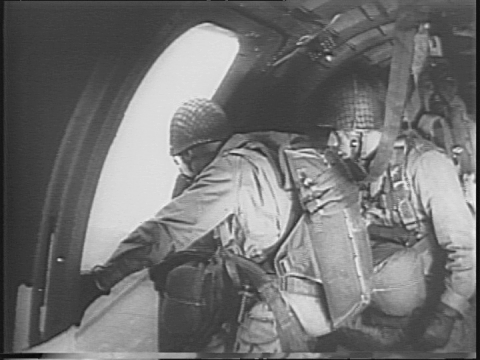
Canham and I were flying in with the commander of the battalion. He was our jump master and number one man in the stick. Number two was the battalion  operations officer (S3), Canham was number three and I was number four man. The battalion commander spent a lot of time standing near the open door while the S3 spent his time standing on the opposite side of the cabin. I don’t know what Canham was doing but I spent a lot of time praying. A chaplain had given me a small paperback book which contained some prayers which had given me comfort in times past and so I read some of this book. The S3 must have seen the concern in my face and when I looked up at him one time he smiled at me and winked. Two days later during the attack on Eindhoven  he was lying on a sidewalk in a pool of blood with a small hole in his head.
Our route to Holland  was over Belgium which was in allied hands. South of Holland we turned north for the final run to the drop zone at Zon. As we flew over Holland the Germans began firing anti aircraft shells and heavy machine gun rounds at us. When I heard that for the first time I asked the soldier next to me what it was. He calmly replied that they were firing at us with machine guns. I had heard them on the ground but never in the air.

Fifteen minutes before an aircraft is scheduled to arrive over the drop zone, the crew chief  notifies the jump master of that fact and the pilot turns on the red light just inside the open
It was a scene such as this in which the
commander of the 3rd Battalion, 506th
Parachute Infantry stood looking for his
check points as we flew into Holland.
door. The jump master orders the men to stand up, hook up, check equipment, and then  sound off for equipment check. When the pilot turns the light to green the jump master goes out closely followed by the rest of the stick. The crew chief gave the word to the battalion commander and the pilot turned on the red light. The battalion commander ordered us to stand up and go through the drill. We were one tense group of soldiers. I had been in combat but this was my first combat jump. However, some of these soldiers had not been in combat and would make their entrance via parachute. The battalion commander stood in the door looking for his check points so that he would know where he was when we jumped. The rest of us waited. Eighteen minutes later the crew chief came back and told the battalion commander that the navigator had made a mistake and that we were then 15 minutes out. When we heard that there were many unpleasant words for the navigator. Now we had to go through that awful wait. This time the
After the pilot turns on the green light we
move out of that aircraft quickly. Note how
close one jumper is to the one in front of
him. His quickness was heightened by the
knowledge that the aircraft might be hit
by German anti-aircraft fire.
navigator got it right and fifteen minutes later we went out the door. Paratroopers are always anxious to get out an aircraft but this time we were more anxious than usual. We could see puffs of black smoke made by  anti aircraft shells as they sought out our planes and exploded. Nobody wanted to be in an airplane when it was struck by an anti aircraft shell and so we were on each other's backs as we went out. I later found out that we had jumped at an altitude of 450 feet. I believed it because no sooner had my parachute canopy opened than I landed on the ground.
As soon as I landed I collapsed the canopy of my chute, looked around and saw Canham. I looked for our equipment bundle, found it immediately and attempted to untie the rope which held the opening closed. It was a tight knot and I was unable to open it so I took my knife from its sheath on my leg and cut the rope, opened the bundle and took out our radio and batteries. By then  Galant and Brasswell had joined Canham and me. The roar of the C47s overhead was loud. A few had been hit by German anti-aircraft fire and had fallen or were falling. Shell fragments from spent anti-aircraft rounds fell close to us. Any C47 that was shot down might fall near us. Both could be dangerous and so the drop zone was becoming an unhealthy place. We had completed the assembly of our FO team, secured our equipment and so we headed for the assembly area of the 3rd Battalion in a portion of nearby woods marked with blue smoke.
 
There was a touch of euphoria in our group. None of us had the experience of mass jump
C-47s dropping their sticks over Holland. I
learned later that we had jumped at an
altitude of 450 feet. I thought that this was
right because I was on the ground no 
sooner had I gone out the door and
 my chute had opened.
during our training but we knew that we had just taken part in a successful one. Everything  went like clockwork. It couldn’t have been better. The adrenalin was pumping so much that it was only after we had been in the assembly area for several minutes that I noticed that I had sliced off a bit of my left thumb cutting the rope on our radio equipment pack. Canham found the battalion commander and we joined his command group. I placed our radio on my back and the batteries on my chest, I  hooked up the antenna and turned the power on. The mission of our FO team was to adjust the fires of British XXX Corps Artillery in support of the 3rd Battalion. Other FOs from the 321st were with the other two battalions.  I attempted to check into its net but was unsuccessful. We thought that perhaps we were out of range of the British and so turned the radio off to conserve batteries. When we were closer to them we would try again.

The 3rd Battalion was the reserve battalion for the 506th Parachute Infantry Regiment. The regiment’s mission was to seize the bridge over the Wilhelmena Canal in Zon. Colonel Robert Sink, the regimental commander had given the 1st Battalion the mission of securing
This is the bridge at Zon before the war.
the regimental objective. As soon as 15 - 25 men came into the battalion’s assembly area they were sent south through the woods. Just before they arrived at the canal they were to swing left and move on the bridge and capture it before the Germans blew it.  Major James L. LaPrade, the commander,  had the battalion on the way in 45 minutes. Major General Maxwell Taylor, the division commander, accompanied the battalion. Meanwhile the 2nd Battalion had completed its assembly and on Colonel Sink’s order moved south on the Zon road toward the bridge. We in the 3rd Battalion followed. On the road to Zon we again tried to contact the British on the radio but were unsuccessful.


Note: Both La Prade and Canham would be killed in Noville on 19 and 20 Dec 44 respectively. They had been outstanding leaders.) 
The 1st Battalion should have been at the bridge before the 2nd Battalion but it was delayed
by fire from a group 88mm guns. The guns were silenced and the advance continued. Because of this delay the 2nd Battalion arrived to within 50 yards of the bridge just as the 1st Battalion came within 150 yards from the flank. At that moment Germans blew the bridge. Just about everything but the center pillar was gone. A moment after the bridge blew LaPrade, Lieutenant Millford F. Weller and Sergeant Donald B. Dunning came running up, took a look, dove into the water and swam to the other side.
Dutch civilians give information to
Colonel Robert L. Sink (center with map),
 commander of the 506th Parachute Infantry.
Meanwhile, our FO team moved south on the Zon road with the 3rd Battalion. It was typical of any approach march. Some forward movement interspersed with many stops. During this Canham told me to take the radio to the Division Artillery (DivArty) communications section and see if its members could repair our radio. The DivArty headquarters was in a wood about one-half a mile west of the road. They were unable to fix my radio and thought that it had been damaged in the drop. This was probably right as we had not had any special packing for such a sensitive radio as the SCR 610. I asked for a replacement and they looked at me as though I were playing with 51 cards.

I hustled back to the road and found my guys as they were continuing the march with the 3rd Battalion. The 3rd Platoon, Company C, 326 Airborne Engineer Battalion (the battalion’s parachute company) had jumped with the 506th. It quickly threw a wooden foot bridge across the canal. The bridge was not as stable as a permenant bridge and only a few men at a time could cross on it. This caused slow movement throughout the column of the 506th.
At about 9:00 P.M. darkness came and it found us tired. We had gone to bed late on the 16th and had been up early on the 17th. Since the jump we had been on the move and carried that heavy radio and extra batteries, in addition to our normal equipment. As we moved through Zon I could hear on the radios of the residents, the BBC broadcasting news of the success of the airborne operation. After having the bridge blow up on us and our slow movement south I didn’t understand what was so successful. Certainly the 1st Airborne Division at Arnhem was not meeting with success. There really wasn’t much success that first day. Perhaps the BBC meant that the drop had been successful. For the 101st it had been.

Because of the slow movement and my fatigue whenever we halted in Zon I moved to the side of the road, leaned against a window of a house and rested the bottom of the radio on 

This is the SCR 610, weight 
approximately 26 pounds.
Riggers had made canvas
bags in which to carry the radio
when on the move.  One bag, on
my back, contained the radio
 while the batteries were in a
bag on my chest..In addition
 to the radio I carried m personal
 gear in a musette bag.
 
the window ledge. This took the weight off my shoulders but didn’t relieve my fatigue and several times to it I dozed and I woke up while I walked down the road. We finally crossed the bridge and moved off to the right of the road into a drainage ditch where we fell asleep immediately. This was a violation of that sacred  rule, “Dig in for the night.” Canham was a careful leader and I can’t understand why he did not insist that we dig in.

While we were moving south from our assembly areas, the Guards Armoured Division, the lead element of XXX Corps, had broken out of its bridgehead over the Meuse-Escart Canal. While initial resistance was stiff, it had advanced to Valkenswaard by 7:30 PM and had halted for the night along with the Royal Engineers who would construct a Bailey Bridge over the Wilhelmina  Canal to replace the bridge which the Germans had blown. On the 18th the Guards Armoured had advanced to the south bank of the Wilhelmina Canal and Royal Engineers began the assembly of a Bailey bridge to replace the blown bridge. It was completed on the morning of the 19th and at 6:45 AM elements of the division crossed the canal 33 hours behind schedule.

On the morning the 18th the 3rd Battalion was the lead battalion for the seizure of Eindhoven. Our FO team was with the 3rd Battalion and we were much closer to XXX Corps Artillery but could still not contact it. Since we were not able to direct its fires Canham decided to make certain that the houses the lead elements of the battalion had by-passed in the early stage of the advance did not harbor any Germans. The radio I carried was too heavy for me to be going into and out of houses and so I stayed outside each house as Canham, Galant and Brasswell went in. They would clear the ground floor. If there was an upper floor they went up and cleared that. If there was no stairway to whatever was above the ground floor they would open the trap door with a pole. In order to see the floor they would find something on which Canham could stand and poke his head into the opening or else one of the others would hold Canham up while he looked around. I thought that all it would take for Canham to have had  a short combat life was a for any German up there to fire at him when he stuck his head up. However, I doubt that any German wanted to sign his death warrant in that manner. Unfortunately, three months later Canham was killed when he did stick his head up to look out a window in the second story of a barn in Noville, Belgium, just north of Bastogne.
Dutch civilians mingle with soldiers of the 
506th Parachute Infantry as they move into
Eimdhoven.
The initial resistance to our advance was from small groups enemy. Despite this crowds of Dutch civilians lined the street as we moved into Eindhoven. They crowded close to us, in some cases, hindering our movement. We were stopped once and started a conversation with a Dutch girl. This went on for a few minutes until the battalion began to move out. Canham, who was carrying a sub machine gun turned around. As he did so the barrel of the gun struck the girl lightly on her buttocks. She gave a small cry and laughed. Canham turned around and saw what had happened. His face became crimson with embarrassment. He apologized, turned and moved out. As I walked down the street I looked back and saw Galant talking with the girl. He was probably making arrangements to see her that evening if we were in the area. It would not be unlike him.


Sometimes when civilians mingled with
soldiers a German bullet or shell would
come screaming down the street and the
civilians would seek cover leaving only
soldiers on the street.
Close in to Eindhoven the German resistance took the form of two 88mm guns. Colonel Sink ordered the 2nd Battalion to move off to the left and deal with the 88s. Soldiers of the battalion  put both out of action. While we were still unable to contact XXX Corps Artillery with our radio, the 506th regimental headquarters did contact Headquarters XXX Corps. Late in the morning the 2nd Battalion secured the center of the city and for the rest of us it was a cake walk as we moved into the city.
For two days I had carried 26 pounds of radio and batteries in order to contact British XXX Corps Artillery. Our radio had tested OK before I packed it but now did not receive or transmit after the heavy landing it made on the DZ north of Zon. Our mission of adjusting fires of British XXX Corps Artillery was not accomplished.

Our FO team moved back to Zon and from the roof of the school house we watched the 
Two gliders, on the final of their approach,
prepare to land. If another glider
flies under or in front of them, they
might have to revise their landing
spots.
reinforcements for D + 2 arrive. This was the third day on which elements of the 101st made the approach to the drop or landings zones. By now the Germans knew the direction of the approach and had brought in additional anti aircraft artillery in order to defend the route. Their defense was effective as they shot down many aircraft. Engraved on my mind is the picture of one C47 which was hit on the approach to the drop zone. By the time it arrived over the drop zone the port engine was on fire and the fire was spreading. The pilot held the aircraft steady as the troopers came out. After that he climbed for 100 feet and then went  into a spin and crashed in a ball of flames. None of the crew got out. Once the gliders cut off from their C47 tugs they had to make their landing. Given the low altitude at which they came in the pilots didn’t have much time to select a landing place, set up the landing, make their approach and land. A few of them collided as they were on their final approach. Some glider pilots were hit with flack and lost control of their glider. Passengers were wounded and had to be evacuated as soon as they landed. Most of the gliders made crash landings. It was not a pretty sight.


We watched some of the landing and then moved to the landing zone. As we were on our way to the assembly area of our battalion, the 321st, we passed a photographer taking pictures. There was a smashed glider nearby with bodies mixed with the wrecked glider. Canham suggested to the photographer that he take a photo of that scene. He replied that we don’t take pictures like that. So much for truth in army photography. We soon located our battalion and Canham reported to Lieutenant Colonel Edward Carmichael, the battalion commander, and we were back home with our battalion
.

Saturday, October 31, 2015

The English Silver Summer


The English Silver Summer
Jay Stone
Sergeant, at the time Private
321st Glider Field Artillery
101st Airborne Division 
 
After the 101st Airborne Division returned from Normandy in mid July of 1944 we were all given a weeks leave. I opted to spend it in Edinburgh which, unfortunately, I found to be a
This is Princess Street, Edinburgh,
 Scotland, one of the most beautiful 
shopping streets in the world. It is,
 of course, a picture taken
after the war.
three night town. Several other soldiers of the 101st felt the same way and so we went to a nearby Army Air Force airfield and asked for a flight to London. Within two hours the AAF had rolled out a C47 and we were on our way to London to spend four nights. London was more than a four night town and I regretted my initial choice of Edinburgh. Not to mind, this was my first leave after 18 months in the Army and I did enjoy it. As it happened it was my only leave.
 
When we returned to our base camp at Whatcombe Farms in England the work-a-day life of soldiers getting ready to return to war began. There were no major exercises, no service practice on Salisbury Plain and no training jumps or glider rides. There was training in loading the gliders and making certain that the loads remained steady in flight. Lessons had been learned about glider employment in Normandy. The big lesson was that every glider landing was a crash landing on which loads not only shifted, but could come smashing forward and wipe out the cockpit and the pilot. The lesson was that glider loads must be even more secure than they had been so they would not come crashing forward during a landing.
 There were major personnel changes in the battalion. Just after we left for Normandy many replacements arrived at Whatcombe Farm to await our return. Battery B had a complete shakeup in the officer ranks. Only one pre-Normandy officer remained. We lost the much respected Ben Skinner as battery commander. He went to battalion as a liaison officer and was replaced by the S2, Fred King, who led us to Berchtesgarten and VE Day. B. Hoff Knight was promoted from assistant executive officer to executive officer. Big Jim Davis, our old exec, was transferred to battalion headquarters as the motor officer, John Jordan, with whom I had gone to jump school and served as a forward observer (FO) in Normandy also left us for the giddy heights of battalion where he was appointed Assistant S2.  None of these changes affected the efficiency of the battery. Our battalion had effective officers who knew their jobs. They performed admirably no matter what their assignment was. In addition, there was no change in the non-commissioned officer leadership. They were the heart of our battery and all remained in place until VE Day. 
The most significant change for me was the assignment of a replacement, Second Lieutenant Francis Canham, to the battery as reconnaissance officer, vice Jordan. With  this, the core of Battery B FO team was formed: Canham, Paul Galant and myself. From time to time a fourth man was added but we three remained together almost until Canham’s death at Noville five months later. A couple of other officers were assigned to the battery as assistant executive officers - read Forward Observers (FOs) - but it would be five months before I had anything to do with any of them.
Paul and I were close. He and I, along with Lieutenant Johnny Jordan, were the only members of B Battery who had gone to jump school. After we returned from jump school in February of 1944 we trained as an FO team on exercises with the 506th Parachute Infantry. Paul been in the battalion for a year before I joined it in November of 1943. He was very intelligent and that was coupled with street smarts honed on the wrong side of Pittsburgh. He was in the instrument section and knew what he was doing.  He had attended a parochial elementary school in which Polish was spoken in the morning and English in the afternoon. His ability in Polish enabled him to speak with many of the displaced persons from eastern Europe we met after the war was over. Paul was inclined to go off on his own: usually when he met a woman. He would not devote much time to meeting one but if, by chance, one came along, he was off. Paul knew and did his job well but he was not a conformist. We all had our own minds but most of us were willing to humor the Army and its ways. So was Paul - most of the time. He stayed just this side of major trouble
The weather that summer was glorious. I am at a loss for words to describe it: Use your favorite description of the perfect English summer.  I don’t remember much about training, there must have been some taking place but it couldn’t have been much. After all, we went to the airports three times for missions to the continent, two of which were scrubbed. With this coming and going, along with the loading at the airfields, there wasn’t much time for training in seven weeks. Somehow there was time for a social life and the major portion of my memory of that summer is of the social life.
The social life for most of us took place in Oxford about 20
White's, our pub, was located down
the street from the Oxford Town
Hall where dances were held.
miles to the north. Each Tuesday and Thursday evening after dinner, trucks took those with passes there.  On Saturdays we left at 1:00 PM. Those times spent on pass were all too short. By the time we arrived in Oxford it was 6:30 P.M.  The bells of a church in Oxford rang the hours and when we heard them ring at 11:00 P.M. we ran for the trucks. On Saturday we usually arrived in Oxford at 1:30 P.M. This made for a reasonable amount of time on pass.
Most of us who rode those trucks had known each other since November of 1943 when Wendell Byrne and I joined the battalion. Wendell was a quite person with a wry sense of humor. His comments on a few well chosen situations usually brought a laugh and in some cases broke tension. He was one of the few jeep drivers in the Detail Section and drove the forward observers up front and left us. No forward observers in the 101st Airborne rode in jeeps while with the Infantry. However, if we needed some equipment, if there was some special food available or even mail for us, Wendell would bring it forward.
Walter Mitchell had been in the battalion from its beginning in 1942. He was short, slender, well built, handsome with black hair and a temper with a short fuze. He also knew what he was doing with respect to Field Artillery but did not suffer those whom he considered to be fools gladly. One time in Normandy he was serving in a forward observer team led by one of our battery officers. He thought that the lieutenant did not know where he was going. Walter told me that if the lieutenant had told them to go down a certain trail he would have shot him. I don’t know about that but I would not have placed any bets either way.
Harry Stearns was the only sergeant in our 25 man detail section which was led by a staff sergeant, Les Sellers. He was the wire sergeant and responsible for wire communication within the battery and to battalion. He was able to socialize with us on pass and still maintain his position as a leader. Harry was a good humored fellow who enjoyed laughing. He was also the only other man in our group who was willing to make the effort to meet girls. We had so little free time that the others felt that it wasn’t worth their time. They could invest a lot of time and end up with nothing; This was time they could have spent with the rest of the group drinking - a poor trade off.
F. E. Stearns was a wireman who was willing to let events carry him along. We got along well but other than one phenomenal event in Austria, I don’t remember much about him. The reason that the event was phenomenal was that it was cast against a fellow who never drew much attention to himself. After VE Day our battalion was on occupation duty in the small village of Grossgmain, Austria. There were many displaced persons there and some of the women were attracted to American soldiers. One Saturday afternoon F. E. walked down a road on the way to his quarters leading a horse by the bridle. An attractive - of course - woman sat on the horse. When they arrived outside of F. E.’s quarters she got off the horse and went inside with him. Women had been in our quarters but I never saw one arrive in such a manner.
In Oxford on Tuesday and Thursday most of our group would head for our pub, White’s, next to the city hall on the High Street. If I didn’t have a date I’d be in that group. By the time we unloaded from the trucks and walked up to White’s it would be 7:00 P.M. The pubs in wartime Oxford were jammed with American servicemen, a few British servicemen and women and fewer civilians. We were usually standing three or four deep in front of the bar. In a way this was good because when you finished a drink there was no instant refill. You had to work your way through the crowd to the bar and then wait for the bartender to serve you. This cut down on our consumption of alcohol and the amount of money we spent. The most popular drink for Americans was beer and, for those who had acquired the taste, bitters. I didn’t like either and so usually had a gin and orange. My love for the taste of scotch was years in the future. We usually spent the night there talking and looking around - always looking around. Sometimes there was a dance in the Oxford City Hall and some of us would go there. These dances and those at the American Red Cross were the best places to meet girls. Some had good luck at these places.
On Saturday our afternoon arrival allowed for a more leisurely pace. We had an hour to spend at White’s which like all pubs closed from 3:00 P.M. until 6:00 P.M.. This left a large void in our day. Once White’s closed we would head for a café on the second floor of a cinema down the street from White’s.  It was impossible to purchase a bottle of whiskey but one of our group knew where to purchase Whiskota, a six ounce bottle of a vile tasting liquid which the bottler claimed was scotch and soda. We would take the Whiskota to a cinema and order cups of coffee all around and, if available, something to eat. We kept the Whiskota under the table. After we finished the coffee we would surreptitiously bring up a bottle and pour the Whiskota into the empty coffee cups. After a while the floor under the table was littered with empty bottles. Management must have noticed this but choose to ignore it. I didn’t drink much - perhaps a couple of bottles of the hated Whiskota - but if I did not have a date, that was my Saturday afternoon fate.

At 6:00 P.M. many had had too much to drink and didn’t care where they went. Some went to the Red Cross for dinner, others back to White’s and who knows where else. Oxford did offer other diversions.
One Sunday during mass at the Black Friars in Oxford I saw Kathleen Wells again. We had met at a dance given by my battalion on the night of Christmas Day, 1943 and had
Black Friars is a Roman
Catholic degree granting
institution of Oxford University
Daily mass is celebrated
there in the chapel. I thought
myself a great sinner in those
days and before mass I normally
went to Confession. The chapel
was often a quiet refuge for me
 away from the intensity of life
in those days.
 
dated for several months after that. Just before we went to Normandy she had thrown me off the bus. It was at this dance that Johnny Jordan met Margot who would become his wife.  Kathleen and I enjoyed seeing each other and began dating again. While the weather was wonderful, spending time with Kathleen is what made the summer delightful for me. She served in the British Army, as a member of the Auxiliary Territorial Service (ATS), the British equivalent of the Women’s Army Corps (WAC). There were many ATS women stationed in Oxford quartered in large houses. Kathleen’s quarters were on the north side of Oxford off the Banbury Road. Fortunately for me the truck parked on the same side of town and so it took me only five minutes to get from her place to the trucks.


If Kathleen and I had a date during the week I was off the truck and headed for her quarters in a flash. (This was in the days, recall, when ladies did not wait around for men but expected them to call for them at their home.) We usually went to the movies once a week. At other times we took a quiet walk or attended a dance at the city hall. Saturday was, for me, more relaxing. Although Kathleen was sometimes on duty Saturday afternoon, we usually managed to spend more time together than we did on a week day evening. We were not into the pub scene but might spend a short time in one, have a gin and orange and go on our way.

When I did not see Kathleen I was stuck with my friends. I don’t mean to be derogatory by that but given the choice of spending time in Oxford with fellows whom I usually spent 24 hours a day or with Kathleen, well, there was no choice.

After I left England for the continent Kathleen and I wrote to each other and she sent me a couple of packages containing some of the items that our PX system did not supply. (What the PX system in the ETO did not supply to combat units would fill convoys of trucks.) We had no playing cards in the Detail Section and so when the package containing a couple of packs arrived in Holland she was Miss Detail Section for the week. I never got back to England but after the war we continued to write for a while until there seemed to be no reason for it

The major event of the summer at Whatcome Farm was “The Attack of the GI’s.” The Farm had been a horse farm and had a large barn which was used as the battalion mess hall. We ate from our mess kits which we rinsed in boiling water in 40 gallon cans (GI cans) before we moved down the chow line and were served our food by the cooks and KP’s. After eating we went outside, scrapped the residue from our mess kits into a GI can and cleaned our mess kits in three other GI cans filled with near boiling or boiling water. The first can contained hot soapy water and with the brushes provided we scrubbed our mess kits clean. Next we dipped them several times into the first rinse and then into the second and final rinse. We took this washing seriously because nobody wanted a case of diarrhea more commonly known as the GI’s.

One morning about half of the battalion did come down with the GI’s. The fact that so many soldiers had the GI’s
The battalion mess hall is on
the right foreground. The
garbage can with stack is for
soldiers to rinse their mess kits
before entering the mess hall.
Further to the right is the
kitchen and the dining area.
It was in this kitchen that "The
Attack of the GIs" took plaace.
indicated that the cooks and/or KP’s had been amiss in cleaning the pots and pans or in the preparation of food. In any case, we all pointed fingers at the cooks. The battalion commander, strangely enough, was a fan of the cooks and pointed his finger at the troops. He concluded that the reason for “The Attack of the GI’s” was that the troops had not cleaned their mess kits properly. One half the battalion, at this one meal, had failed to clean their mess kits properly. Of course, this was preposterous but he was the battalion commander and for the next week sergeants supervised our cleaning of our mess kits. The story speaks for itself.

As for out masters, First Allied Airborne Army and British Airborne Corps,  they spent their days and many nights dreaming up missions for us. Each time a mission was planned, our comrades on the ground on the continent overran the objective. Our masters planned sixteen operations, two of which came close enough to execution so that we went to the airfields, were briefed and were only hours from takeoff when they were canceled. In the first, Operation Transfigure the101st would be dropped and landed south of Rambouillet. The 506th, of which the 321st would be in direct support, was to block the Paris- Chartres road. The earliest possible D-Day was 19 August. On the 17th, Third Army overran Chartres and the mission was scratched.

Before we could leave the airfields Major General Maxwell Taylor, the division commander, visited each field in order to address his troops. Our FO teams were out there with the 506th when General Taylor mounted the platform. His words - and I am not making this up: “Men, as you know our mission has been canceled and I can see the  in your eyes.” This man must have had phenomenal vision. I couldn’t see his eyes and I have no idea into whose eyes he was looking; neither mine nor those of the riflemen around me. We were enjoying that beautiful English summer, and many of us were also enjoying the company of His Majesty’s most attractive subjects. We were ready and willing to go back to war but nobody was disappointed that were not going at that moment. Perhaps the regimental commander, Colonel Robert Sink was disappointed.

When the airborne elements of the division went to the airfields for this, the first scratched mission, the seaborne logistical tail boarded ships, crossed the English Channel and landed at Omaha Beach. Thus, they thus entered the campaign for Northern France and were awarded a battle star on their ETO ribbons for this. And so the logistical elements of the division participated in all five campaigns in the ETO while the combat elements made it for only four campaigns. When, after VE Day, points to establish priority to go home were computed, the seaborne elements of the division had five more points than did the combat elements and some seaborne members went home earlier than did some of the combat elements. Such were the fortunes of war.

The next operation for which we went to the airfields was Linnett I, in which we would have dropped in an area near Tournai, Belgium. I was worried about the jump for this operation. In my training at the division jump school in February of 1944 I had made five jumps with no equipment: bare bones.  This time I was to jump not only with my weapon and equipment but with my 50 pound radio, packed into a canvas bag, strapped to my right leg. I had never seen, let alone trained with, this equipment. In order to get out of the aircraft when I came to the door, I had to shove my right foot - the one with the 50 pound radio strapped to it - out the door. The prop blast would do the rest and drag me after my leg. There was a release attached to the canvas bag which I was to pull as soon as my chute had deployed. The bag would then hang from my leg by a 20 foot cord.  Of course, I had to use the cord to let that bag down slowly so that  it did not take my leg with it. As soon as the radio bag hit the ground I was to go into my parachute landing fall. I did not like this one bit. This would truly be on the job training. My concerns went for naught as the British Second Army overran our objective and we continued to enjoy the English summer and the company of those attractive subjects..

The next trip to the airfield finished off my Silver Summer. Operation Market-Garden was on. Our battalion, the 321st Glider Field, was to be in direct support of the 506th Parachute Infantry Regiment. Our FO team, operating with the 3rd Battalion of the 506th, consisted of Canham, Galant, myself and a replacement, John Q. Brasswell. Canham and Galant were to jump in with the commander of the 3rd Battalion while Brasswell and I were to jump with the executive officer. Canham and Galant were, by far, the most qualified Field Artillerymen in the team. I suggested to Canham that if his aircraft went down, the battalion would be left with Brasswell and myself as FOs. This was, to say the least, a less than desirable situation; far less than desirable. I pointed out that if anything happened to him, Galant was the best qualified to take over and that he should consider each of them riding in different aircraft. He saw the wisdom of this and selected me to fly in with him. Galant and Brasswell were to go in with the battalion executive. Such was my contribution to the planning of Market-Garden. Take off for D-Day was 10:15 A.M. on September 17th. I knew that this would be a go when at dinner on the 16th we were served steak and fruit cocktail.

 The latter was a delicacy in the ETO and when it and steak - which never made our menu - were served, while I wouldn’t say that we were being fattened up for the slaughter, the air did take on an ominous quality. My feeling was reinforced when the C47s, that would carry us to Holland, began landing as dinner was ending. Those pilots wanted their share of the steak and fruit cocktail.
 
The mission of the 101st Airborne Division was to seize several bridges and towns and hold open a stretch of road,
Eindhoven to Uden. This was a 16 mile portion of the road, Eindhoven to Arnhem, over which British XXX Corps would travel in order to reach the British 1st Airborne Division which had the mission of seizing the bridge crossing the Rhine River at Arnhem.
 
The mission of the 506th was to secure the bridge over the Wilhelmina Canal at Zon and then seize Eindhoven. The 1stBattalion was given the mission of securing the bridge. As
The bridge at Zon - pre war -
which was to be seized by
 the 1st Battalion,
506th Parachute Infantry
15 to 20 soldiers gathered in its assembly area, off the drop zone at Zon, the battalion commander planned on dispatching them through the woods south to the bridge site at Zon. This demonstrates that the commander had much faith in the ability of the soldiers of the battalion to, in effect, assemble on the march.  It also demonstrates the importance the commander placed on seizing that bridge at Zon. The 2nd Battalion was to assemble in the woods off the DZ and then, on order, move toward Zon. Our FO team was to be with the 3rd Battalion which, after assembly, would be in reserve.


The next day, the 17th, we were up early, drew our parachutes and other equipment. I drew an equipment bag and packing for our radio and batteries. The packing would line the equipment bag and cushion the radio when the bag hit the
Paratroopers wait to board a
C47 for the flight to Holland
September 17, 1944
ground. The bag was going to be hung on an equipment rack under the wing of the aircraft in which we would fly to Holland It would be released when we jumped. I packed the radio and a soldier from the air force hung it from the wing of our aircraft. I carried my individual and personal equipment in a musette bags hanging in front of my chest and from a web belt. I don’t remember what I had in the musette bag other than rations. I carried my folding carbine in a scabbard from my web belt on which I also carried a canteen, ammunition, a compass and a wound dressing. Shortly before boarding the aircraft we put on our parachutes, the main on our backs and the reserve on our chests


After we boarded the pilots fired up the engines of the many C47s on the field that day. The roar was unimaginable. There
Twenty five paratroopers
sit on bucket seats during
the flight to Holland,
September 17,1944
must have been more than a hundred aircraft all with two engines roaring. We taxied to the end of the runway, got the signal to take off and the pilot gunned that ship down the runway. Even today on commercial aircraft I feel a charge when the aircraft accelerates down the runway and is soon airborne. It’s a thrill each time. It was different on that day, though. It was a thrill but I was off on my first combat jump and the adrenaline was racing through my body.  I was sitting on a bucket seat and just beside my ears those piston powered engines were vibrating fiercely and hammering a sound no longer heard on the aircraft on which I travel. As we lifted off I probably said goodbye to England and its people- an England which had been so kind to me and which I was not to see again for 30 years. There must have been a special goodbye to Kathleen whom I was to miss during the next year on the continent. But then, the Army did not send me to the ETO for its good social life and I knew that and was content. After all, I was in that C-47 because it was where I wanted to be.
September 17th was a Sunday, another beautiful day by which to remember an England of which I was growing
The English countryside is
always beautiful but it was
particularly beautiful during the
wartime summer of 1944.
fonder all the time.  Many airborne soldiers had made dates for the 16th, a Saturday. On that evening we were locked into airfields and we could not let anyone know where we were. A lot of young women must have had evil thoughts about their dates on that Saturday, thoughts which were probably dispelled when on Sunday morning they saw the airborne armada thundering eastward. And so, The Silver Summer was over and I was headed to war once again.

Monday, October 12, 2015

At War in Normandy


Utah Beach, with its gentle rise from the sea
inland, lent itself to an amphibious landing as
 opposed to Omaha Beach which had high
 bluffs overlooking the beach.
After landing on June 7th we moved into an assembly area just to the rear of Utah Beach and dug in and spent the night there. On July 8th there wasn't much to do and so many of us went down to the beach and did some sightseeing. There was a lot of damaged equipment and many damaged vehicles there. Despite these losses the soldiers of the 4th Infantry Division who landed there continued with their move inland.

On June 6th soldiers of the
4th Infantry Division cross
Utah Beach and move inland.


On our second night in Normandy, July 8th, as we were lying in our slit trenches, Bed Check Charlie in the form of a German fighter-bomber flew over our position. My first thought was: “Dear God, please don’t let anyone fire at him.” The chances of hitting him were remote and if left alone he would probably move on. This time God did not answer my prayers. A caliber .50 antiaircraft machine gun opened up on him and sent up a stream of tracer bullets. Charlie was able to locate the offending weapon from the stream of tracers. Sure enough, he went into a dive. Immediately I realized that my training in digging in was seriously deficient. I wished that I was much deeper into the soil of France than I was. In any event. Charley’s bomb struck home and hit some ammunition trucks. For some time the ammunition in those trucks was going off. Having decided that I was not dug in deeply enough, I made that trench much deeper. This was the last time that I was to be caught in a slit trench that was too shallow when I had time to dig in. This was a deficiency in our training inasmuch as we had never dug in then. Even in combat no non-commissioned officer checked our slit trenches.

On 9 June our howitzers and other equipment were unloaded from SS John Morseby. As some of the men from our battalion were moving ashore from a landing craft a spent anti-aircraft round landed nearby wounding eleven of them. This event was to have serious consequences for the personnel warrant officer who was with the rear echelon at Whatcombe Farms.

Just before we left for Normandy the personnel warrant officer had collected money from some members of the battalion and was supposed to transmit it to the person indicated by the soldier. This officer played the racing dogs at a nearby btrack, He used some of the money collected from the soldiers in order to make his bets at the track. As mght be expected he lost and was unable to repay the losses. When his use of the fjunds was discovered he was court-martialed and sentenced to five years at the military prison at Fort Leavenworth, Kansas.

On the evening of the 9th the battalion crossed the Douve River and went into position northeast of Carentan in direct support of the 327th Glider Infantry Regiment which had the mission of seizing Carentan. Cannoneers dug in their howitzers, ammunition was unloaded, radio nets were established, wires were laid and FO parties and liaison sections joined the infantry.

We were at war.

One of our earliest missions was firing in support of the 1st Battalion, 327th Glider Infantry Regiment during its crossing of the Douve River on the night of 9 June. The first forward observers from BatteryB sent forward, Lieutenant John Jordan, Corporal Paul Galant and Private First Class Howard Krivos, made the crossing. As soon as the crossing was made engineers from the 49th Engineer Battalion built a bridge across the river and the remainder of the regiment crossed on it. Galant and Krivos were wounded on the next day and evacuated. Another soldier from the detail section and I were sent up to replace them. As we drove up close to the front in the jeep, some riflemen of the 327th were crouching in ditches on both sides of the road. “Wonderful,” thought I, “Here I am riding down the center of the road while these experienced - two days - riflemen are in those ditches.” We found Johnny Jordan and went to work with him.

On page 245 of Rendezvous with Destiny: A History of the 101st Airborne Division, by Paul Rappaport and Arthur Northwood, Jr., there is a picture of wounded soldiers lying on stretchers on the deck of an LST. Galant is on the fourth stretcher from the bottom with his helmet protecting a vital part of his anatomy. He was taking no chances.

The 327th was advancing on Carentan from the northeast and from the east. Other
Soldiers of the 101st Airborne Division enter
Carentan. While there has been some
damage to the city, it is not extensive.
regiments of the division were moving from directions with the aim of surrounding the town. The Germans put up stiff resistance on 10 and 11 June but withdrew from the town on the night of the 11th before the town was encircled and taken on the 12th. The quick seizure saved much damage to the town.

On the 13th and 14th we were engaged in local actions in order to secure favorable defensive positions which we occupied. On June 17th we supported the 327th Glider Infantry in an attack to improve observation of its area of operations. We remained in our positions until June 29th. This represented the last real combat for the 101st.

On the 29th we moved north to a position just south of Valgones where the division set up a defensive line across the peninsular while other divisions engaged in the capture of Cherbourg. We saw no action here and had seen our last combat in Normandy.

Johnny Jordan was a piece of work in those days. He was a real tiger. It seemed to me that he wanted to take on the German Army all by himself. I told him, “Take it easy, Lieutenant, there are plenty of others who would like to get a piece of the German Army. Save some of it for them.” Later Johnny Jordan was severely wounded outside of Bastogne. After evacuation he did not return to the battalion. And so, all the members of the first FO party that Battery B sent into combat with the Infantry were wounded.
 
The wounds of Galant and Krivos were not of the million dollar variety and both were waiting for us when we returned to Whatcombe Farm in the middle of July after Normandy. Howard was wounded early on once again as an FO in Holland. I don’t recall how long he was away from us as a result of this wound but somebody did something right. Howard was assigned to the battalion Fire Direction Center. “O and 2” is not a good count for an FO to be facing. He was a bright person and quickly learned that FDC stuff.

Only a few incidents in the Battle of Carentan stand out in my memory.  The 377th Parachute Field Artillery jumped into Normandy at about H-5. They jumped 12 pack 75 mm howitzers, each howitzer in three loads. They were able to assemble one howitzer and that along with some captured German artillery enabled them to get some rounds off. In the end the captured artillery was not as effective as hoped. Many of the officers and men of the battalion were attached to our battalion. One of those officers, a lieutenant, was sent up as an FO and I was a member of his team. Things must have been relatively quiet because the lieutenant was off searching a dead German while I was attempting to obtain a drink of Calvados, about which I had heard much but knew nothing. I found a farmer who agreed to give me some Calvados, about one-half a glass. I took a healthy swallow of the stuff and immediately began gasping for air while thinking that this was a hell of a way for a soldier to die. I thought that I had been poisoned. I hadn’t been but I was off Calvados for life after that.

Another time we were using a farmer’s house for an observation post (OP). Our food supply was not plentiful just then and so we purchased dairy and other products from the farmer. We had been on D rations for several days. D rations were solid chocolate bars which contained lots of the food elements that could keep one going for a few days. We bought some milk from the farmer and made chocolate milk from the D rations and the milk. We also obtained fresh eggs which had not graced our mess halls for two years. The highlight of this farmer’s food stock was rabbits which he kept for sale and eating, much as some kept chickens. We were asked to select the rabbits that we wanted to eat. The farmer then slaughtered, dressed and cooked them.

On July 10th we moved to Utah Beach, boarded LSTs
This is LST 282 delivering vehicles to Utah Beach.
It was on such a vessel that the we returned to
Whatcombe Farms after our combat in Normandy.
and in two days were back at Southampton in the U.K. where we boarded trains for the trip to Whatcombe Farm, our home station. There was never a happier band of soldiers. The train ride was exhilarating. At many points along the way there were British civilians who seemed to know that we were just returned from Normandy and cheered us. We returned the cheers and displayed our German helmets, Nazi flags and other booty. It was good to be a soldier who had survived.

At Whatcombe Farms we pulled maintenance on our equipment, cleaned up and took off on one week furloughs.
Princess Street in Edinburgh is one of the most attractive
 shopping Streets I have seen. This is, of course, is a
picture taken long after the was had ended.
I went to Edinburgh, stayed three days and then, along with 20 other Airborne soldiers, went to London. I don't know why I went to Edinburgh. Perhaps it was because I had spent 48 hours there after I had graduated from jump school and thought that I was an old London hand. As soon as I arrived in Edinburgh I went to the local Paramont dance hall. I met a young ATS sergeant there , walked her home afterwards and asked to see her on the following night. In fact, I had a vision of staying in Edinburgh for the week and seeing her each evening. It wasn't to be. She told me that she was engaged and wasn't dating other men.

Twenty other Airborne soldiers and I decided that Edinburgh was a three night town and convinced the commander of a nearby troop carrier squadron to  roll out a C47 for a private flight to London. Except for the blackout and the soot from the wood fires of the city I recall nothing of my four days in London. After that we all returned to Whatcombe Farms and prepared for whatever our masters had in store for us.